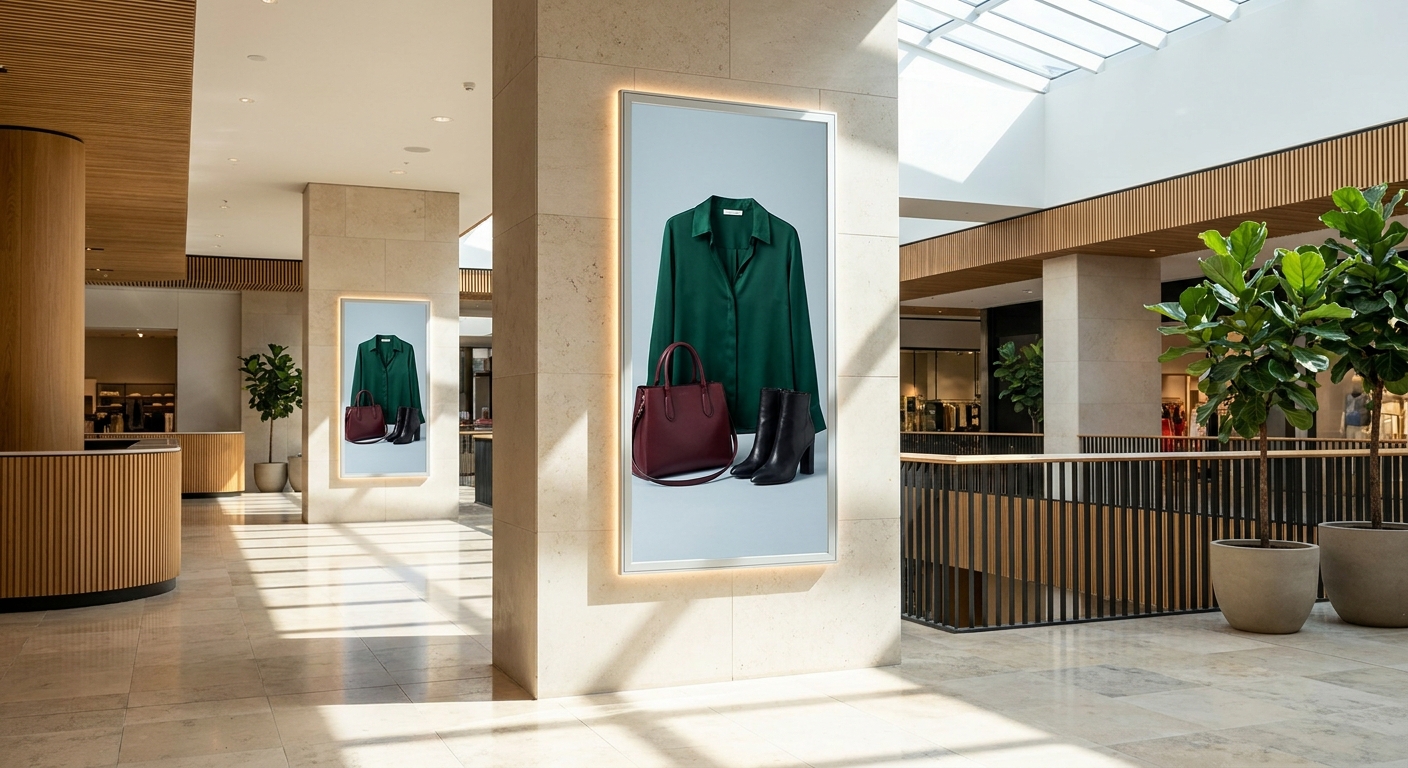
Buying a single illuminated frame is a small decision. Buying the signage for an entire concourse is a programme: forty or sixty units across three levels, a mix of sizes, several mounting conditions, one graphic-change crew, and a hard reopening date. Get it right and the centre reads as one coherent environment for the next decade. Get it wrong and you inherit a mismatched fleet where every unit needs a different bracket, a different graphic size, and a different conversation.
Mall signage light boxes are almost always bought this way — as a fleet, by a landlord's fit-out team, a property manager, or a tenant coordinator working to a centre-wide standard. This is what actually decides whether that purchase works.
Start with a size schedule, not a size
The single most common mistake in a concourse programme is picking one "standard" size and then fighting the building. Concourse conditions are not uniform. A column wrap wants a tall narrow format. A between-tenant pier wants something closer to square. A lift lobby wants a wide landscape unit sitting above a handrail. An escalator flank wants a run of identical portrait units at a consistent centreline.
Because we build to exact dimensions rather than to a stock catalogue, the right approach is to survey the centre first and produce a schedule — say, twenty-four 30"×70" portrait units for the retail piers, eight 48"×36" landscape units for the lift lobbies, six oversized units for the atrium. Each is made to the number on the drawing. There is no rounding down to the nearest standard size and no filler panel hiding the difference.
That schedule is also what makes the graphics programme cheap later. If your piers are all one dimension, your print supplier runs one file, one nesting, one shipment. The savings compound every campaign for as long as the centre operates.
Brightness: you are competing with the building, not the dark
Mall interiors are bright. Skylit atriums, high-output downlights on the walkway, and glowing shopfronts on both sides mean a concourse sign is never seen against a dark background — it is seen against a lit one. A printed graphic in an unlit frame is a reflective surface in that environment, and it disappears.
An LED snap frame changes the physics. The graphic is lit from behind through a lightguide, so it is emitting rather than reflecting, and it holds its saturation under ambient light that would flatten a printed poster. In practice that is the whole reason mall signage is illuminated at all.
Two specification notes that matter across a fleet:
Specify dimming and use it. Every unit we build is dimmable and works with wall dimmers or remote-controlled dimmers. An atrium unit under a skylight and a unit in a shaded back corridor should not run at the same output — matching them by eye at commissioning is what makes a fleet look deliberate rather than assembled.
Keep colour temperature consistent across the order. A mixed fleet bought over three years from three suppliers is instantly readable as a mixed fleet: one run goes slightly green, another slightly blue, and the concourse looks patched. Buying the run at once, from one manufacturer, is the only reliable fix.
Design for the graphic change, because that is the recurring cost
Hardware is a one-time cost. Graphic changeovers are forever. A concourse typically turns over its creative for seasonal campaigns, tenant promotions, and centre events — call it six to ten changes a year across every unit.
Front-loading is what makes that survivable. A snap frame opens from the front: the four aluminium profiles hinge open, the old graphic lifts out, the new one drops in, the profiles snap shut. No tools, no removing the unit from the wall, no disconnecting anything. On a run of forty units in a concourse, the difference between a front-loading frame and a rear-access box is the difference between one overnight shift and a week of scheduled access.
Two things to write into the spec while you are there. First, decide where double-sided units are genuinely needed — a frame mounted perpendicular to the walkway on a column or a freestanding position is seen from both directions, and a single-sided unit throws away half its impressions. Second, agree who holds the spare graphics and where. A tidy signage programme dies quietly when the second set of prints ends up in a storeroom nobody has keys to.
Mounting conditions, surveyed before you order
Concourse substrates vary more than people expect: drywall piers, stone-clad columns, structural steel behind a cladding cavity, glass balustrades. Because the frames are custom-built, the sensible sequence is to survey the mounting condition first and then order — not to order and discover that the stone column cannot be drilled where the bracket expects.
Every unit ships with its UL/ETL-approved power supply included, sized with 20% extra capacity, so the electrical coordination question is where the supply lives and how it is reached for service — not whether you need to source one separately. On a column installation that usually means a serviceable access point at the base rather than a driver buried behind stone.
Lead time, volume pricing, and the reopening date
Fit-out programmes are date-driven. Most of our orders ship within one to two weeks, with smaller orders going out in as little as two days and rush available on request — which is a very different planning horizon from an overseas order placed against a container schedule.
Everything is manufactured in-house at our Richmond Hill, Ontario facility, so the person you talk to about a revised size on unit 27 is in the same building as the machine that cuts it. Volume pricing applies at five units and up, which almost every concourse programme clears comfortably. Shipping is free within Canada, and units ship duty-free and tax-exempt to the US under CUSMA — relevant if the centre is one of several across a cross-border portfolio.
What happens in year two
The question no one asks at quote stage is the one that decides whether the programme was a good purchase: what happens when a unit fails halfway through a campaign, in a public concourse, on a Saturday.
Every unit carries a 3-year warranty and LEDs rated for 50,000+ hours, and every product is CSA/UL certified — which is not a marketing line in a shopping centre but a condition of the electrical inspection you will be signing off. Just as importantly, buying a matched fleet from one manufacturer means a replacement in year two is the same unit, in the same dimensions, at the same colour temperature. Ordering a single replacement is not a problem: our minimum order is one unit, custom-built to the same schedule as the original run.
That is the underrated argument for buying the concourse at once and buying it custom. The hardware is the easy part. The programme is what you are actually specifying.
Working on a concourse, common-area or multi-store signage package? Send us the schedule — sizes, quantities, mounting conditions and your in-service date — and we'll quote the run and confirm the lead time against it. See the full range of LED snap frames at primelightboxes.com, or ask for a custom quote directly.