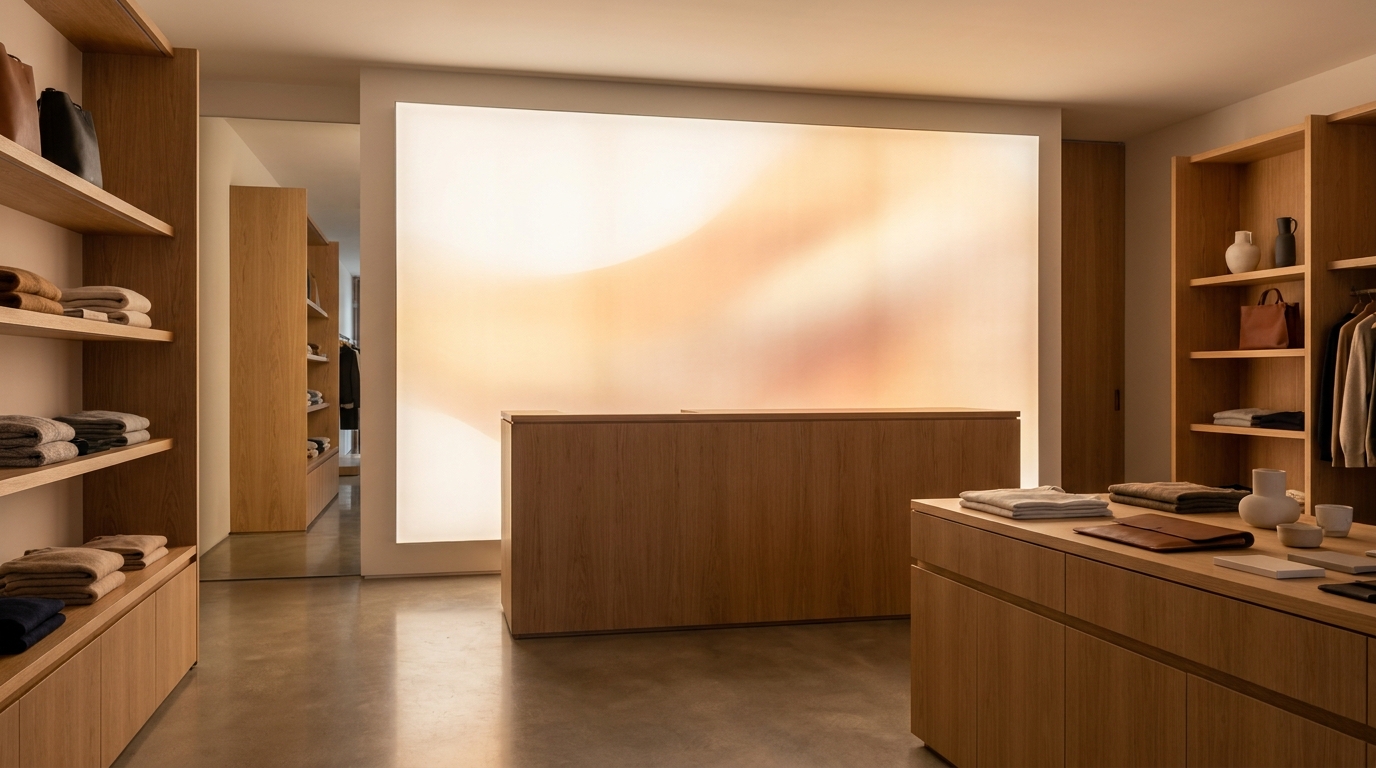
Walk through a well-designed store, hotel lobby, or trade show floor built in the last few years and you will notice a particular kind of display: a large illuminated graphic with no visible frame, no glare, no hardware, no seam. The image appears to float on the wall as a plane of even light. That is a fabric light box, and it has quietly become the default choice for spaces where a printed sign or a screen would look wrong.
This guide covers what a fabric light box actually is, why it displaced older backlit display formats, where it fits, and what to look at when specifying one for a real project.
What a Fabric Light Box Is
A fabric light box is an aluminum extrusion frame packed with LED modules, faced with a printed fabric graphic that is tensioned across the opening. The graphic isn't laminated, clipped, or held behind acrylic. It has a thin silicone bead sewn into its perimeter — the industry calls this SEG, for silicone edge graphic — which presses into a channel around the frame. Push the bead into the groove with your fingers, work your way around, and the fabric pulls itself flat and drum-tight.
The result is a display with no border. The graphic runs edge to edge, and the frame disappears behind it. Prime Light Boxes builds these in 2" and 3" profiles: the 2" for wall-mounted work where the goal is a nearly flush plane, the 3" for freestanding, double-sided, and larger-format units that need the extra depth for light diffusion.
Because everything is manufactured to order in our Richmond Hill, Ontario facility, the frame is cut to the dimensions of your space rather than the other way around. There is no standard-size catalogue to design around, and the minimum order is one unit.
Why Fabric Replaced Acrylic-Faced Displays
For years, backlit retail signage meant a printed translucent film sandwiched behind an acrylic sheet in a visible frame. That format still exists, and it still has uses, but fabric has taken over most premium interior applications for four reasons.
No glare. Acrylic is a reflective surface. Under retail track lighting or near a storefront window, an acrylic-faced box throws hot reflections that wash out the graphic from exactly the angles customers approach from. Printed fabric is matte. It scatters incident light instead of bouncing it back, so the image stays readable from every position in the room.
Graphic changes take minutes, not a service call. Pulling a tensioned fabric graphic out of its channel and pressing a new one in is a two-person, ten-minute job with no tools. Seasonal campaign changes, menu updates, and promotional cycles stop being a logistics problem. The replacement graphic also ships flat in a small box, which matters more than people expect when you are updating twenty locations at once.
Fabric scales without seams. Printed fabric can be produced and sewn in sizes that acrylic sheets cannot reach in one piece. A ten-foot lobby feature wall in fabric is one continuous graphic. The same wall in acrylic is a panelized assembly with visible joints.
It reads as architecture, not signage. A frameless illuminated plane sitting flush in a wall looks like a designed element of the room. A framed box on the wall looks like something that was hung there afterward. In hospitality and high-end retail, that distinction drives the specification more often than any technical spec does.
Where Fabric Light Boxes Fit
Retail interiors. Feature walls behind the cash wrap, illuminated end caps, window displays facing the sidewalk, and campaign graphics that rotate on a seasonal schedule. The fast graphic swap is usually the deciding factor.
Hotel and restaurant interiors. Lobby feature walls, illuminated menu boards, and ambient graphic panels in corridors and elevator lobbies. Fabric's soft, diffuse light works better than a screen in spaces meant to feel calm rather than active.
Corporate lobbies and offices. Reception walls, wayfinding, and brand graphics. A single large fabric panel behind a reception desk does the job that a screen would do at a fraction of the visual noise and none of the maintenance.
Events and trade shows. Double-sided freestanding units in the 3" profile break down and reassemble repeatedly. The graphic packs into a tube; the frame packs flat.
Residential feature walls. Less common, but growing. A large backlit fabric panel in a home theatre corridor or a basement stairwell produces soft ambient light without a visible fixture anywhere in the room.
For projects where the surface should be translucent stone rather than printed fabric, the same illumination problem gets solved with acrylic light panels or high-output backlit panels instead — different faces, same underlying engineering.
What Actually Separates a Good Unit from a Bad One
Most fabric light boxes look similar in a photograph. The differences show up on the wall.
Even illumination across the whole face. The failure mode of a cheap box is visible hotspots and banded brightness where the LED modules sit, especially in the corners. Fixing that is a function of LED placement, module spacing relative to cavity depth, and the diffusion layer behind the fabric — none of which you can evaluate from a spec sheet. It is worth seeing a sample lit before committing to a large order.
Frame rigidity. A tensioned graphic pulls inward on all four sides with real force. An underbuilt extrusion bows slightly at the mid-span of a long run, and once the frame bows, the fabric develops a soft wave that catches light and never quite goes away.
Power supply sizing. Every Prime Light Boxes unit ships with a UL/ETL-approved power supply, specified with 20% extra capacity beyond the load. That headroom is why the driver runs cool and lasts. It is included with every unit, never sold separately, and it is one of the first places corners get cut in a commodity product.
Certification and warranty. Every product we build is CSA/UL certified — necessary for commercial installations, and non-negotiable for any electrical fixture going into an occupied space. The LEDs are rated for 50,000+ hours, and every unit carries a 3-year warranty.
Dimming. Units are dimmable and compatible with standard wall dimmers or remote-controlled dimmers. In a hospitality setting where the room changes character between lunch and evening, that is not a nice-to-have.
Specifying One for a Real Project
Start with the finished opening dimension you want, not a size from a catalogue. Everything is cut to order, so the display fits the wall rather than forcing the wall to accommodate the display.
Then decide on profile and mounting: 2" surface-mounted or recessed for a near-flush wall plane, 3" for freestanding, double-sided, or larger-format units. Confirm the power feed location early, because it determines whether the cable runs cleanly inside the wall or has to be surface-routed afterward.
Plan for at least one spare graphic if the display is part of a rotating campaign. Producing the second graphic alongside the first is cheaper and faster than ordering it in isolation four months later.
Lead time on most orders is one to two weeks, and small orders can ship in as little as two days. Rush production is available on request. Shipping is free within Canada, and units ship duty-free and tax-exempt to the United States under CUSMA. Volume pricing applies at five units or more, which is worth raising early on any multi-location rollout.
Fabric light boxes start at $330. If you want to talk through a specific wall, send dimensions and a photo of the space to sales@primelightboxes.com — you will be talking to the people who build the product, not a reseller.