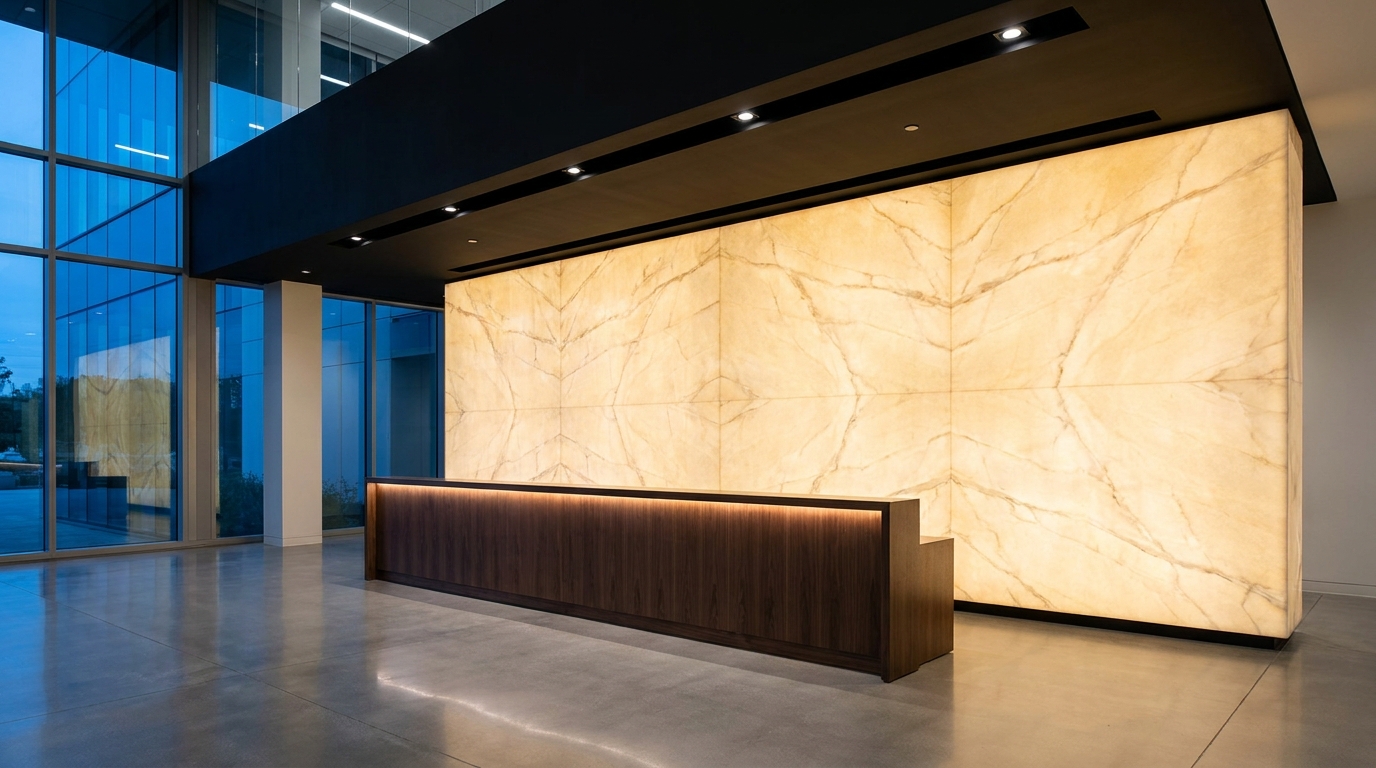
Most illuminated feature walls fail for the same reason: somebody picked the panel type before they knew what the panel had to do. The two options — edge-lit and backlit — look nearly identical in a rendering. Installed, they behave nothing alike. One is thin enough to slip behind a stone slab in a millwork cavity you can barely fit a hand into. The other pushes enough light through three-quarter-inch marble to make it read from across a lobby.
Getting the choice right is mostly a matter of knowing how each one is actually built. Here's the difference, and how to decide.
How edge-lit acrylic light panels work
An edge-lit panel is a sheet of optical-grade acrylic with LEDs mounted in the frame around its perimeter, firing sideways into the edge of the sheet. The light travels through the acrylic by total internal reflection until it hits a laser-etched or printed diffusion pattern on the back face, which kicks it forward toward the viewer. The etch pattern is deliberately uneven — denser toward the middle, sparser near the LEDs — so the surface reads as one flat, even glow rather than four bright edges and a dim centre.
The payoff is thickness. Because there's no LED sitting directly behind the face, an edge-lit panel can be remarkably thin while still producing genuinely uniform light. That makes it the right answer when your cavity depth is the constraint: backlighting a stone countertop apron, a translucent onyx shower surround, a recessed niche, or any millwork detail where the fabricator left you almost no room to work with.
Our acrylic light panels are built to any dimension up to 48" × 96", with RGB available where a project calls for colour change. Above that footprint the physics start working against you — light has to travel too far from the perimeter to hold even brightness — which is exactly where the other panel type takes over.
How high-output backlit LED panels work
A backlit panel flips the geometry. Instead of firing light in from the edges, LED bars run in rows throughout the body of the panel, directly behind the diffusion layer, firing straight at it. A calculated air gap plus a diffuser sheet blends those individual rows into a single continuous field of light.
Two things follow from that. First, brightness: you're no longer limited by how far light can travel through acrylic, so you can push far more output through a dense material. Second, and more importantly, there's no size ceiling. Because the light source is distributed across the whole back surface rather than concentrated at the perimeter, a backlit panel can be built to essentially any dimension — a full-height lobby wall, a bar front, a twelve-foot stone feature — and hold the same even illumination corner to corner.
That combination is why backlit panels are the default for large-format work: translucent stone feature walls, backlit wine racks, reception desk fronts, and any application where the material in front of the light is thick, dense, or heavily veined.
Choosing between them: four questions
How deep is the cavity? This decides more projects than anything else. If the millwork or stone installer has left you a shallow reveal, edge-lit is likely your only option. If you have room to build out, backlit opens up.
How thick and how dense is the material in front? Thin translucent acrylic, printed graphics, and light-coloured onyx pass light easily and are well served by edge-lit. Thick slabs, dark or heavily figured stone, and dense marble need the raw output of a backlit panel to read properly.
How big is the illuminated area? Under 48" × 96", either can work. Over that, backlit — full stop. Trying to gang edge-lit panels across a large wall introduces seams and brightness variation right where the eye is most likely to catch it.
Do you need colour? RGB is available on our acrylic panels where a space calls for tunable or shifting colour. Most architectural stone and signage work stays with fixed warm or neutral white, because colour-shifting light distorts how the material's natural veining reads.
What stays the same either way
Whichever panel type your project calls for, the build standards don't change.
Every panel is designed and manufactured in-house at our Richmond Hill, Ontario facility — not assembled from imported parts. Every unit is CSA/UL certified to North American electrical safety standards, and every one carries a 3-year warranty with LEDs rated for 50,000+ hours.
We build to your exact dimensions only. There are no fixed or standard sizes to compromise around, and the minimum order is a single unit — so a one-off residential niche gets the same treatment as a fifty-panel commercial rollout. Volume pricing kicks in at five or more units.
Every panel ships with a UL/ETL-approved power supply sized with 20% extra capacity, always included and never sold separately. All panels are dimmable and work with standard wall dimmers or remote-controlled dimmers, which matters more than people expect: a stone feature wall that looks perfect at night is usually far too bright at noon.
Most orders ship in 1–2 weeks, with smaller units going out in as little as two days and rush production available on request. Shipping is free within Canada, and US orders ship duty-free and tax-exempt under CUSMA.
The specs to send us
You'll get an accurate quote faster if you have these ready:
- Finished illuminated dimensions — the visible glowing area, not the framing opening
- Available cavity depth — the honest number from the fabricator, not the drawing
- The material going in front — species and thickness of the stone, or the substrate for a graphic
- Mounting condition — recessed, surface-mounted, or integrated into millwork
- Dimming method — wall dimmer or remote
- Power access — where the electrician can land a circuit
If you're unsure which panel type fits, send the cavity depth and the material spec and we'll tell you straight. We build both, so there's no incentive to steer you toward the wrong one — and since you're talking directly to the people manufacturing the panel, you'll get an answer based on what will actually work in your opening.
Browse the full range of custom light panels at primelightboxes.com, or send your drawings and we'll spec it with you.